Charlton Heston Reads From the New Testament
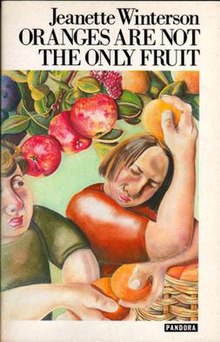 Commencement edition | |
| Author | Jeanette Winterson |
|---|---|
| Country | United Kingdom |
| Language | English language |
| Genre | Semi-autobiographical |
| Publisher | Pandora Press |
| Publication appointment | 21 March 1985 |
| Media type | Print (Paperback) |
| ISBN | 0-8021-3516-1 |
| OCLC | 15792328 |
| Followed by | Boating for Beginners |
Oranges Are Non the Only Fruit is a novel past Jeanette Winterson published in 1985 past Pandora Press. Information technology is a coming-of-age story nigh a lesbian girl who grows upwardly in an English Pentecostal customs. Fundamental themes of the volume include transition from youth to adulthood, complex family relationships, aforementioned-sex relationships, organised organized religion and the concept of faith.
It has been included on both GCSE and A-Level reading lists for pedagogy in England and Wales,[1] and was adapted by Winterson into a BAFTA-winning 1990 BBC idiot box drama serial of the same name.
Background [edit]
The book is semi-autobiographical and is based on Winterson's life growing up in Accrington, Lancashire. "I wrote about some of these things in Oranges, and when it was published, my mother sent me a furious note".[two] A parallel not-fictional account of her life at this time is given in her 2011 memoir, Why Be Happy When You Could Be Normal? [3] Although the protagonist of Oranges bears the author'south offset proper noun, John Mullan has argued that it is neither an autobiography nor a memoir, but a Künstlerroman.[4]
Premise [edit]
The main grapheme is a young girl named Jeanette, who is adopted by evangelists from the Elim Pentecostal Church. She believes she is destined to go a missionary. The book depicts religious enthusiasm equally an exploration of the power of honey. As an boyish, Jeanette finds herself attracted to some other daughter, and her mother's group of religious friends subject field her and her partner to exorcisms.[5]
Allusions to other works [edit]
The novel is divided into eight sections, each of which is named after ane of the first eight books of the Bible (Genesis, Exodus, Leviticus, Numbers, Deuteronomy, Joshua, Judges and Ruth.)[6] Every bit a outcome, each chapter often contains references and allusions to their corresponding book in the Bible.
The novel besides contains references to numerous other literary works, historical figures and aspects of popular culture:
- Jeanette'southward female parent frequently lauds the good and moral behaviour of the titular character in Jane Eyre, by Charlotte Bronte.
- Jeanette compares her mother to William Blake.
- Jeanette's bang-up-uncle is described as a stage-actor, who at least once performed every bit Hamlet to favourable reviews.
- The owner of the local pest-control shop, Mrs. Arkwright, shares the same proper noun with the similarly miserly possessor of the local grocery store in Open All Hours, a popular BBC sitcom that originally ran from 1976-1985.
- Jeanette'southward mother is subscribed to the religious magazine The Obviously Truth, which was issued monthly past The Worldwide Church building of God from 1934 to 1986. In the novel the family receive a weekly subscription.
- Whilst visiting Jeanette in infirmary, Elsie reads "Goblin Market" by Christina Rossetti, and poems by William Butler Yeats, including 'Lapis Lazuli'.
- Jeanette and her mother see The 10 Commandments, starring Charlton Heston, at the picture palace.
- For her Easter-Egg painting contest entry, Jeanette paints her eggs as characters from Wagner'south opera-bicycle The Ring of the Nibelung, including the Germanic heroine Brunhilda.
- She as well creates artworks based on the 1942 film Now, Voyager, and the Tennessee Williams play A Streetcar Named Desire.
- At her local library, Jeanette reads a version of the French fairy tale Beauty and the Brute.
- Jeannette's female parent is shown to be a fan of country and gospel vocalizer Johnny Greenbacks.
- In her new oversized raincoat Jeannette is reminded of seeing The Man in the Iron Mask - although which film version remains unspecified.
- Feelings of misery remind Jeanette of the poet John Keats.
- The short, abstract section entitled 'Deuteronomy' alludes to The Legend of Atlantis, the mythical city of El Dorado, Saint George and the Second World War.
- Later in the novel, a dislocated Jeanette dreams of a library where a number of young women are shown to be translating the epic Old-English verse form Beowulf.
- Toward the shut of the novel, Jeanette is depicted on a train reading George Eliot'south Middlemarch.
The novel is interspersed with short stories that bear many resemblances to (and draw influences from) traditional Biblical stories of the Old Testament, tales of Arthurian Fable (specifically related to Thomas Malory's Le Morte d'Arthur) and other popular fairy tales.
Reception [edit]
The novel won Winterson the Whitbread Award for a First Novel in 1985.
Although it is sometimes referred to as a "lesbian novel",[seven] Winterson has objected to this label, arguing, "I've never understood why straight fiction is supposed to be for everyone, but annihilation with a gay character or that includes gay experience is simply for queers".[5]
Adaptations [edit]
A tv set adaptation of the book was made and aired by the BBC in 1990, starring Charlotte Coleman and Geraldine McEwan, which won the Prix Italia in 1991.[eight]
The book was released on cassette past BBC Audiobooks in 1990, also read past Coleman.[9]
A 2-role dramatisation, adapted by Winterson and starring Lesley Sharp, was circulate on BBC Radio 4 in April 2016.[ten]
Legacy [edit]
The novel has been included on both GCSE and A-Level reading lists for teaching in England and Wales, including the OCR English Literature A-Level module "Literature Post-1900".[1]
References [edit]
- ^ a b 68995-unit of measurement-f662-literature-post-1900-coursework-guidance
- ^ Jeanette Winterson.'Why be Happy When Y'all could be normal.'ISBN 9780099556091
- ^ Brightwell, Laura (July 30, 2012). "Why Be Happy When You Could Exist Normal? (review)". The New York Times . Retrieved Apr 27, 2013.
- ^ 'True stories', John Mullan, The Guardian, 27 October 2007.
- ^ a b Winterson, Jeanette. "Interview on Jeanette Winterson's official site". Retrieved August 20, 2010.
- ^ "Oranges Are Not the Only Fruit: The Bible". 20 Oct 2007.
- ^ Beirne, Rebecca (2008). Lesbians in goggle box and text afterwards the millennium . New York: Palgrave Macmillan. p. 39. ISBN978-0230606746.
- ^ Prix Italia, Winners 1949 - 2010, RAI Archived 2013-10-22 at the Wayback Auto
- ^ ISBN 978-0-563-41070-6
- ^ "Radio iv adaptation". Retrieved 26 Dec 2016.
Farther reading [edit]
- Bentley, Nick. "Jeanette Winterson, Oranges Are Not The Only Fruit". In Contemporary British Fiction (Edinburgh: Edinburgh Academy Printing, 2008), 108–117. ISBN 978-0-7486-2420-i.
reginanerisfamands54.blogspot.com
Source: https://en.wikipedia.org/wiki/Oranges_Are_Not_the_Only_Fruit

Post a Comment for "Charlton Heston Reads From the New Testament"